Instructor-led • live & hands-on

Master Rust, fearlessly.

A complete, hands-on journey through the Rust programming language, from your first cargo new to ownership, traits, lifetimes, iterators, fearless concurrency, async, unsafe, macros, and FFI. Three levels, eighteen weeks, one fearless systems programmer: you.

8weeks
Liveonsite + online
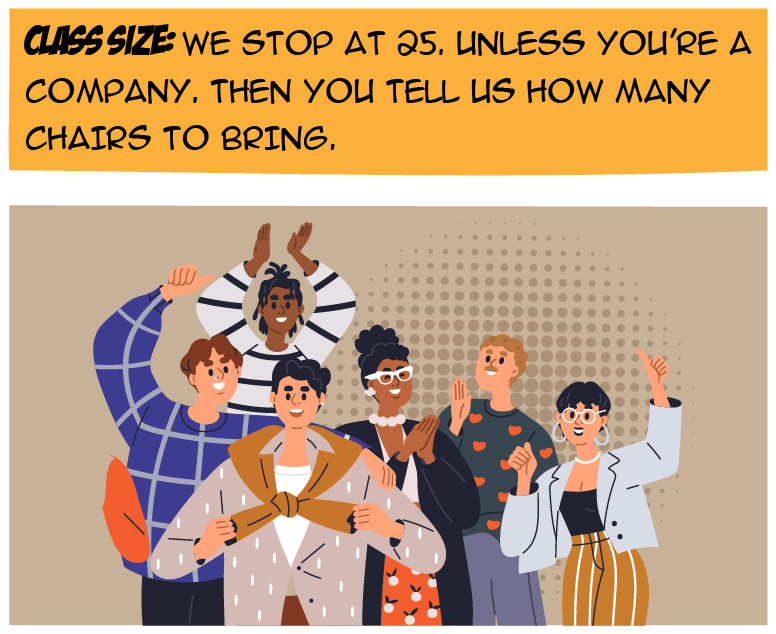
Max 25students per class
Zeroto unsafe
main.rs compiles & runs
// ownership, borrowing, zero-cost, all checked
use std::thread;
use std::sync::{Arc, Mutex};

fn main() {
    let counter = Arc::new(Mutex::new(0));
    let mut handles = Vec::new();

    for _ in 0..8 {
        let c = Arc::clone(&counter);
        handles.push(thread::spawn(move || {
            let mut n = c.lock().unwrap();
            *n += 1; // no data races. guaranteed.
        }));
    }
    for h in handles { h.join().unwrap(); }
    println!("result = {}", *counter.lock().unwrap());
}
$ cargo run  →  result = 8   // fearless concurrency, by design
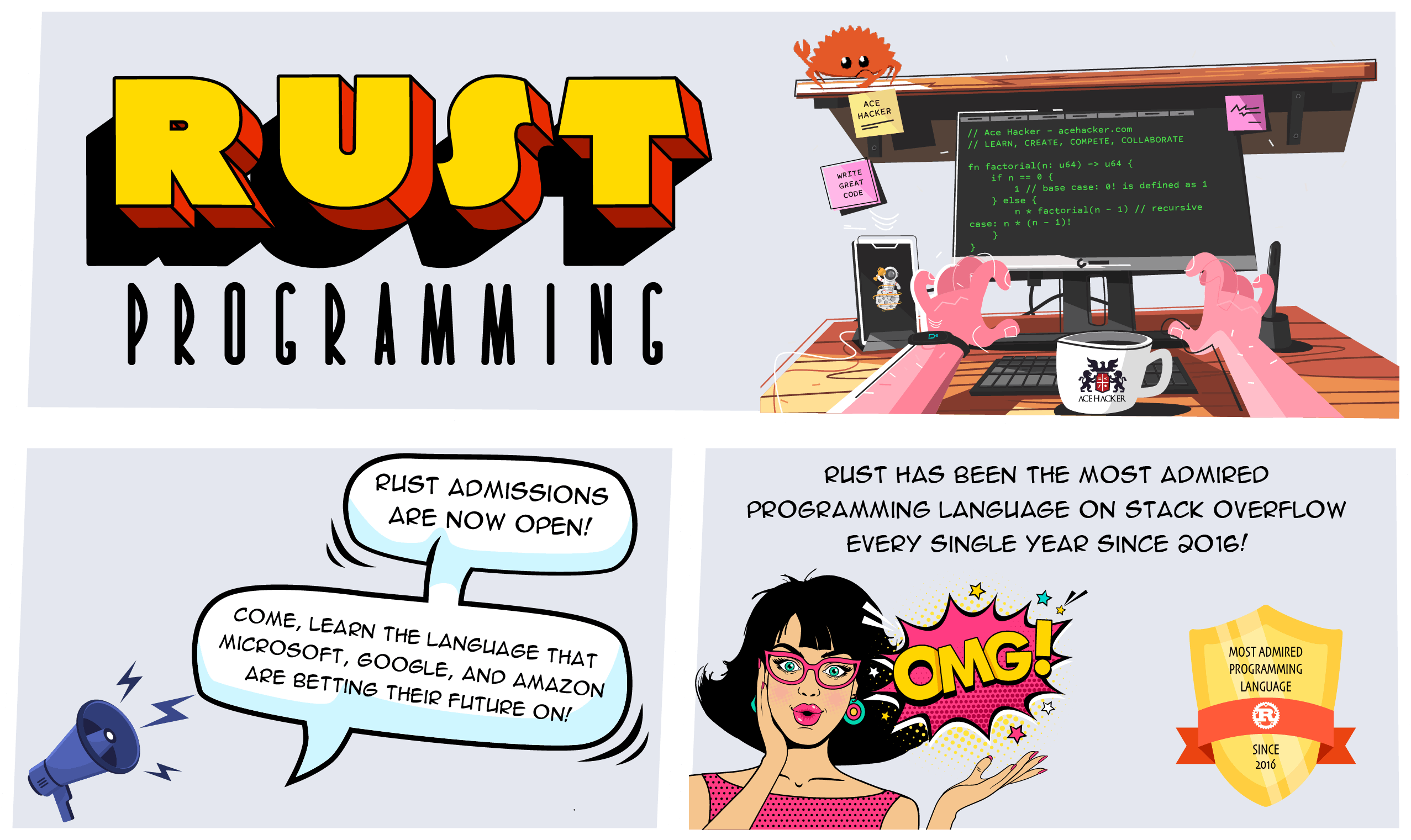
Rust has been the most admired programming language on StackOverflow every year since 2016!
Rust

Most admired programming language.

Rust has been the most admired programming language on Stack Overflow every single year since 2016. A full decade. No other language comes close. The Linux kernel is being written in it. Microsoft, Amazon, Google, Meta, Cloudflare, and Discord all run it in production.

Rust developers are among the highest paid in the industry, and demand is growing faster than supply. Whether you want to build operating systems, game engines, web backends, or embedded firmware, Rust opens every door.

Check Schedule ↓

Instructor-led Rust Course
Instructor-led

Learn Rust live, not from a playlist.

This is an instructor-led course. You will learn live, whether onsite or online if you would rather join virtually. Ask questions, get real-time help fighting the borrow checker, and pair with your trainer in a real class.

With small class sizes (max 25), you will not just watch, you will write real Rust, break each other's code kindly, and ship working programs alongside your instructor and classmates. No recorded videos, no skipping ahead, no pausing forever, just real, engaging learning.

Who can join this course? →
Who can join

No prior Rust required. Real progress guaranteed.

Never written a line of code before? Perfect. You can still join our Rust course. We start right at the beginning and assume absolutely no prior programming knowledge, even if you secretly have some. We’ll build things up from the basics, step by step, so you don’t have to arrive speaking fluent computer.

To keep cohorts friendly and paced right, we group learners into squads by age and experience:

15 - 17years
18 - 22years
23 - 30years
31+years
Check Schedule ↓
Rust Developers
Small classes • hybrid

Cozy classes. Learn from anywhere.

Just 25 students max per class means more questions, more answers, and far more "aha!" moments. Ace Hacker is a hybrid / HyFlex classroom, so you can code with us in the room or from the other side of the planet.

Max 25 students in a class

Small Class Size

Personalized attention for every curious coder, so nobody is left silently fighting a lifetime error. Easier to collaborate, make friends, and feel like part of a crew.

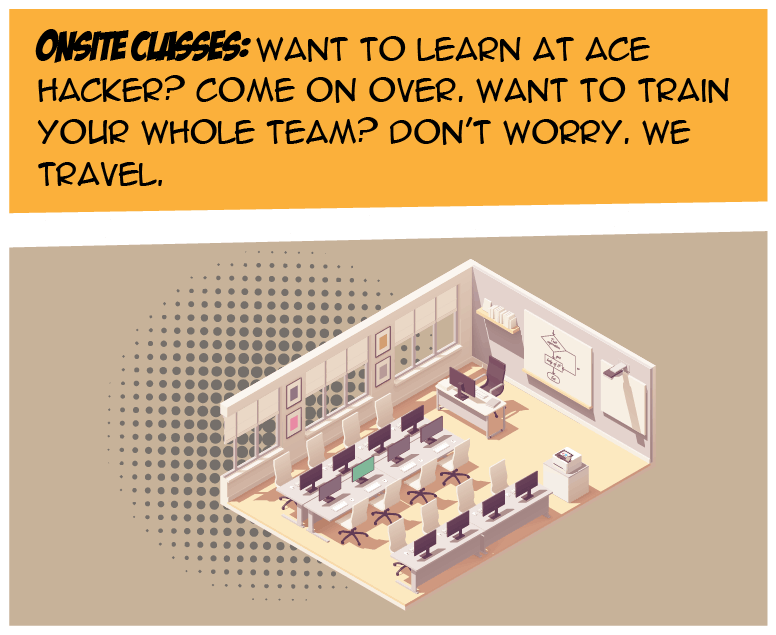
Onsite Classes

In Bangalore? Join your classmates at Ace Hacker, J.P. Nagar 7th Phase, with fast internet, an amazing teacher, and chai, coffee, and snacks in class.

Online Classes

Tuning in from Tokyo, Timbuktu, or just too tired to cross Bangalore? Join the same live class online. All you need is a screen and an internet connection.

Syllabus

From hello, world to unsafe and async.

This is the full, week-by-week breakdown. Each level contains everything before it. The course tracks the latest stable Rust and the current edition, with cargo, clippy, and rustfmt from day one.

First 4 weeks. Start from zero and finish able to read, write, and ship real Rust programs, with ownership already in your bones.
Movement 1

Setup, syntax & scalar types

Get the toolchain running and meet Rust's core syntax and primitive types.
  • Installing Rust with rustup
  • The toolchain: rustc, cargo, rustfmt, clippy
  • Editions & the latest stable release
  • Hello, world! and Hello, cargo!
  • cargo new, build, run, check
  • Anatomy of a Rust program; fn main
  • Packages, crates & modules (intro)
  • Comments & doc comments
  • print!, println!, eprintln!
  • Formatting: {} vs {:?}, positional & named args
  • Variables & mutability (let, mut)
  • Constants (const) and static
  • Shadowing
  • Integer types i8..i128, u8..u128, usize
  • Floats f32/f64, bool, char
  • Numeric literals, underscores, type suffixes
  • Type inference & annotations
  • Operators; integer overflow behavior
  • Tuples & destructuring
  • Arrays & indexing; bounds panics
Movement 2

Control flow & functions

Make decisions, repeat work, and structure logic into functions and expressions.
  • Functions, parameters, return values
  • Statements vs expressions
  • The unit type ()
  • if/else as an expression
  • loop, while, for
  • break with values; labeled loops
  • Ranges a..b, a..=b
  • Iterating ranges, arrays & slices
  • The match expression
  • Match arms, literals, ranges, _
  • Binding with @; match guards (intro)
  • Blocks as expressions
  • Nested conditionals & early returns
  • Stack vs heap (intro)
  • Exercises: FizzBuzz, temperature, primes the Rust way
Movement 3

Ownership, borrowing & structs

The heart of Rust. Learn the rules that make Rust memory-safe with no garbage collector.
  • Ownership: the three rules
  • Move semantics; String vs &str
  • Copy vs Clone
  • Ownership & functions (moves in/out)
  • References & borrowing (&, &mut)
  • The borrowing rules; the borrow checker
  • Dangling references, prevented
  • Slices: string slices & array slices
  • UTF-8, chars() vs bytes
  • Structs: define, instantiate, access
  • Field init shorthand; struct update syntax
  • Tuple structs; unit-like structs
  • Methods & impl blocks
  • &self, &mut self, self
  • Associated functions (::new)
  • Deriving Debug; printing structs
Movement 4

Enums, collections & error handling

Model data with enums, use the core collections, handle errors, and ship a small CLI.
  • Enums & variants with data
  • The Option<T> enum
  • match with Option
  • if let / else, while let
  • Vec<T>: push, index, iterate
  • String: build, concat, format!
  • HashMap<K,V>: insert, get, entry
  • Ownership with collections
  • panic! and when to use it
  • Result<T,E>: Ok / Err
  • unwrap, expect, and their risks
  • The ? operator (intro)
  • Modules, paths, pub, use
  • Splitting code across files
  • Adding a crate from crates.io
  • First unit tests: #[test], cargo test
Cornerstone project

Ship a real command-line tool

Put week 1 to 4 together into a working CLI, a grep-style search tool or a units converter, complete with argument parsing, file I/O, error handling with Result, and a passing test suite.

Next 2 weeks. The abstractions that make Rust powerful and the idioms that make it a joy.
Movement 5

Generics & traits I

Write code once and reuse it across types, safely and with zero runtime cost.
  • Generic functions
  • Generic structs & enums
  • Generic methods
  • Monomorphization & zero-cost generics
  • Defining traits
  • Implementing traits for types
  • Default trait methods
  • Traits as parameters; impl Trait
  • Trait bounds T: Trait, where clauses
  • Multiple bounds with +
  • Returning impl Trait
  • Derivable traits: Debug, Clone, Copy
  • PartialEq, Eq, Hash, Default
  • PartialOrd, Ord
  • Implementing Display by hand
Movement 6

Lifetimes & advanced traits

Teach the compiler how long references live, and push traits further.
  • Why lifetimes exist
  • Lifetime annotation syntax
  • Lifetimes in functions
  • Lifetimes in structs & methods
  • Lifetime elision rules
  • The 'static lifetime
  • Generics + bounds + lifetimes together
  • Associated types
  • Operator overloading (Add, Index…)
  • Default generic type parameters
  • Supertraits
  • The newtype pattern & the orphan rule
  • Blanket implementations
  • Marker traits (intro)
Movement 7

Closures & iterators

The functional core of idiomatic Rust, and one of its most loved features.
  • Closures & environment capture
  • Fn, FnMut, FnOnce
  • move closures
  • Closures as parameters & return values
  • The Iterator trait & next()
  • Adapters: map, filter, take, skip
  • enumerate, zip, chain, flat_map
  • Consumers: collect, sum, fold
  • reduce, count, for_each
  • any, all, find, position
  • Lazy evaluation
  • iter vs iter_mut vs into_iter
  • IntoIterator
  • Writing a custom iterator
  • Iterators as zero-cost abstractions
Movement 8

Error handling & smart pointers I

Handle failure like a professional, and meet Rust's heap-allocating pointers.
  • Result combinators: map, map_err
  • and_then, or_else, unwrap_or
  • ? with Result and Option
  • Custom error enums
  • The std::error::Error trait
  • Error conversion via From
  • thiserror for libraries (intro)
  • anyhow for applications (intro)
  • Box<T> for heap allocation
  • Recursive types with Box
  • The Deref trait & deref coercion
  • The Drop trait & cleanup
  • std::mem::drop
Movement 9

Smart pointers II & collections

Shared ownership, interior mutability, and choosing the right container.
  • Rc<T> reference counting
  • RefCell<T> & interior mutability
  • The Rc<RefCell<T>> pattern
  • Borrow rules at runtime
  • Reference cycles & leaks
  • Weak<T> to break cycles
  • VecDeque, BTreeMap, BTreeSet
  • HashSet, BinaryHeap
  • Choosing the right collection
  • The entry API in depth
  • Slice patterns
  • Sorting, dedup, and searching
Movement 10

Modules, crates, testing & tooling

Organize, document, test, and package Rust like the ecosystem does.
  • Module system: super, self, re-exports
  • pub use & clean public APIs
  • Cargo workspaces
  • Cargo.toml in depth; SemVer
  • Feature flags
  • Publishing to crates.io
  • Doc comments ///, //!
  • Doc tests & cargo doc
  • Unit vs integration tests (tests/)
  • #[should_panic], Result tests, #[ignore]
  • Test organization & fixtures
  • clippy & rustfmt in depth
  • The dbg! macro & debugging
Keystone project

Build a library crate the ecosystem would accept

Design and publish a small, generic, well-tested library, for example a typed config loader or a mini data-structure crate, with trait-based APIs, custom errors, full docs with doc tests, and a clean clippy report.

Last 2 weeks. The deep, low-level, weapons-grade Rust: fearless concurrency, async runtimes, unsafe, macros, FFI, and squeezing out every last nanosecond.
Movement 11

Fearless concurrency I

Threads, message passing, and shared state, with data races caught at compile time.
  • Spawning threads; join
  • move closures with threads
  • Message passing: mpsc channels
  • send / recv; multiple producers
  • Shared state: Mutex<T>
  • Arc<T> thread-safe counting
  • The Arc<Mutex<T>> pattern
  • RwLock<T>
  • Deadlocks & how to avoid them
  • The Send and Sync traits
  • Compile-time thread-safety guarantees
Movement 12

Fearless concurrency II & parallelism

Go lock-light and data-parallel, and understand the memory model underneath.
  • Atomics: AtomicUsize & friends
  • Memory ordering: RelaxedSeqCst
  • Scoped threads (thread::scope)
  • Thread-local storage
  • Data parallelism with rayon
  • par_iter & parallel adapters
  • Work-stealing (conceptual)
  • Condvar & Barrier
  • Mutex poisoning
  • Lock-free concepts (intro)
  • Benchmarking parallel speedups
Movement 13

Async Rust I

The futures model and the Tokio runtime that powers modern async Rust.
  • async/.await fundamentals
  • The Future trait & poll
  • async fn & async blocks
  • Executors & runtimes
  • Tokio & #[tokio::main]
  • Spawning tasks: tokio::spawn
  • Async I/O: tokio::fs, tokio::net
  • Timers & delays
  • join! & select!
  • Cooperative scheduling
  • Blocking vs non-blocking work
Movement 14

Async Rust II

Streams, pinning, async sync primitives, and a real async service you build.
  • Streams (futures::Stream)
  • Pin & Unpin (practical)
  • Async channels: mpsc, oneshot, broadcast
  • Async Mutex / RwLock
  • Cancellation & timeouts
  • Structured concurrency patterns
  • Error handling in async
  • Tracing & async debugging
  • Build: an async TCP service
  • Build: a tiny async HTTP server
  • Backpressure & graceful shutdown
Movement 15

Unsafe Rust & memory

Step past the safe subset deliberately, and build sound abstractions over it.
  • The five unsafe superpowers
  • Raw pointers *const T, *mut T
  • unsafe functions & blocks
  • Safe abstractions over unsafe
  • static mut and its dangers
  • Unions
  • Memory layout: repr(C), alignment
  • size_of, align_of
  • transmute (and why to avoid it)
  • MaybeUninit, ManuallyDrop
  • Undefined behavior & the nomicon mindset
  • Checking unsafe code with Miri
Movement 16

Macros & metaprogramming

Generate code at compile time, from tidy declarative macros to full proc macros.
  • Declarative macros: macro_rules!
  • Patterns, repetition, fragment specifiers
  • Macro hygiene
  • Building small DSLs
  • Procedural macros (intro)
  • Derive, attribute & function-like macros
  • syn & quote (conceptual)
  • Writing a custom #[derive]
  • Build scripts (build.rs)
  • Conditional compilation (cfg, features)
  • When NOT to reach for a macro
Movement 17

FFI, systems & no_std

Talk to C, drop the standard library, and write genuinely low-level Rust.
  • The C ABI & extern "C"
  • Calling C from Rust; bindgen (intro)
  • Calling Rust from C; #[no_mangle]
  • Representing C types; -sys crates
  • Linking & build integration
  • no_std programming
  • Bare-metal & embedded concepts
  • #[global_allocator]
  • Custom allocators (intro)
  • Panic handlers in no_std
  • Build: a fast, memory-safe systems tool
Movement 18

Performance, optimization & capstone

Measure, then make it fast, then ship a real binary anywhere.
  • Zero-cost abstractions revisited
  • Profiling: perf, cargo-flamegraph
  • Benchmarking with criterion
  • Release profiles, LTO, codegen-units
  • Avoiding allocations; SmallVec, arenas
  • SIMD & portable-simd (intro)
  • const fn & compile-time evaluation
  • Const generics in depth
  • Cross-compilation & targets
  • Static binaries with musl
  • Idiomatic API design guidelines
  • Code review & shipping
Capstone project

Build a high-performance, concurrent systems tool

Bring the whole course together into one serious artifact, a concurrent or async network service, a fast file/packet processor, or a safe wrapper over a C library, profiled, benchmarked, cross-compiled to a static binary, and reviewed for idiomatic, production-grade Rust.

What Rust gives you

Four superpowers most languages make you choose between.

Rust is the reason Firefox, the Linux kernel, Discord, Dropbox, and half of modern infrastructure run faster and crash less. By the end of this course, these four are yours.

Safety
Safety

Memory safety, no GC

No null pointers, no data races, no use-after-free, and no garbage collector pausing your program. The compiler proves it at build time.

Concurrency
Concurrency

Fearless concurrency

Write multi-threaded and async code and let the type system reject data races before they ever run. Concurrency stops being scary.

Zero-cost abstractions
Abstractions

Zero-cost abstractions

Iterators, generics, and traits compile down to code as fast as hand-written loops. High-level style, low-level speed, no tradeoff.

Rust is fast
Performance

Blazing performance

C and C++ class speed with modern ergonomics. Predictable, no-runtime, control-every-byte performance you can actually reason about.

Schedule & fees

Pick a pace that fits your life.

Weekday and weekend batches. Timings are in India Standard Time. Choose the format that suits you, or ask us and we will help you plan your schedule.

Weekday batches
Weekday batch

Weekdays, Mon - Thu

Roughly two hours a day after work or college, so you keep momentum through the week without losing your whole day.

Batch Timings (IST) Starts on Fee + 18% GST Total payable
Batch 110:00 AM - 11:30 AMOct 05, 2026₹ 24,000 + ₹ 4,320₹ 28,320Enrol Now
Batch 212:30 PM - 2:00 PMOct 05, 2026₹ 24,000 + ₹ 4,320₹ 28,320Enrol Now
Batch 33:30 PM - 5:00 PMOct 05, 2026₹ 24,000 + ₹ 4,320₹ 28,320Enrol Now
Batch 46:30 PM - 8:00 PMOct 05, 2026₹ 24,000 + ₹ 4,320₹ 28,320Enrol Now


Weekend batches
Weekend batch

Weekend, Sat & Sun

Longer three-hour sessions on the weekend for people who would rather keep weekdays clear and go deep in fewer, meatier classes.

Batch Timings (IST) Starts on Fee + 18% GST Total payable
Batch 510:00 AM - 1:00 PMOct 10, 2026₹ 24,000 + ₹ 4,320₹ 28,320Enrol Now
Batch 63:00 PM - 6:00 PMOct 10, 2026₹ 24,000 + ₹ 4,320₹ 28,320Enrol Now
Certification

Leave with proof, not just skills.

Complete a level and earn a certificate in Rust Programming. Based on your performance across exercises, projects, and the capstone, you receive one of two.

Top tier

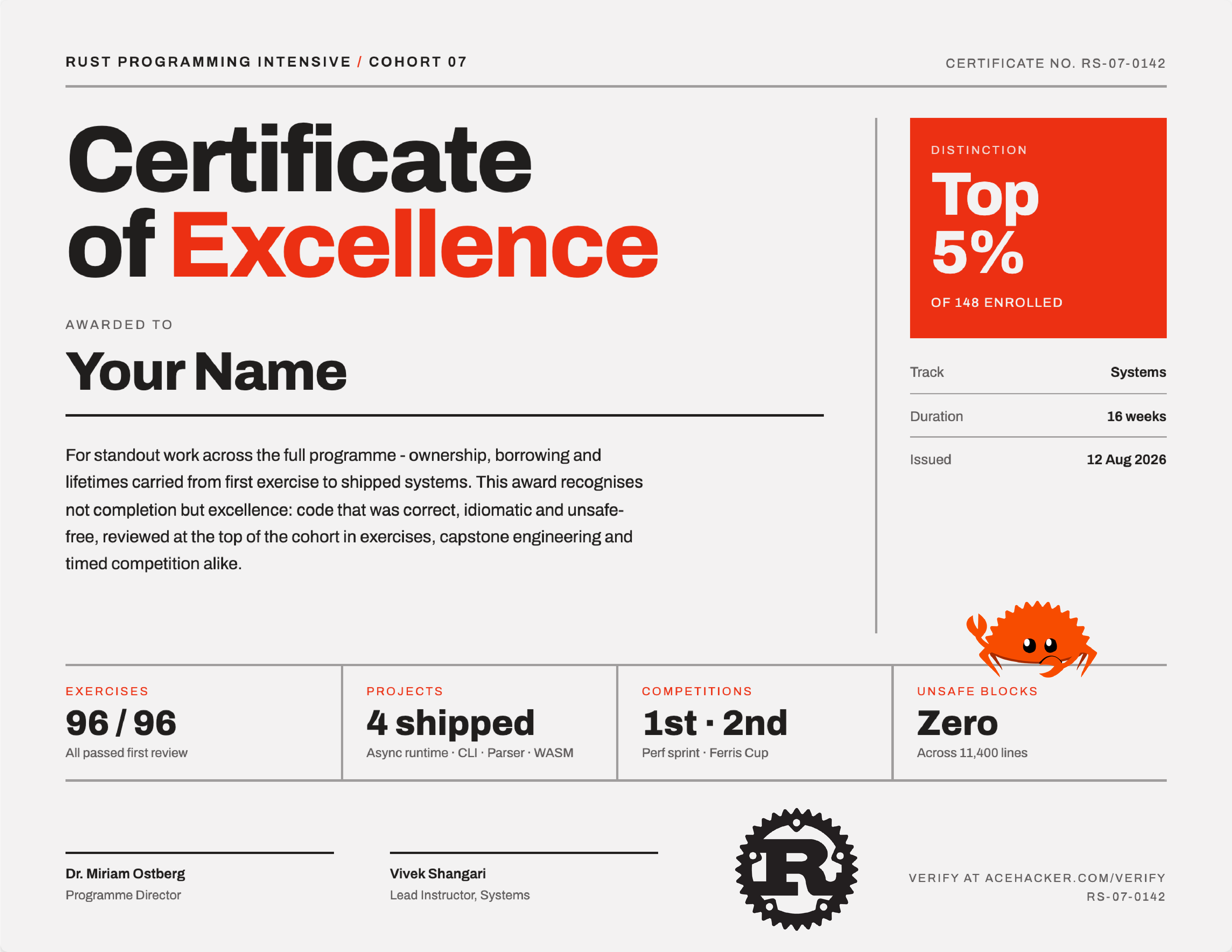
Certificate of Excellence

Certificate of Excellence in Rust

Awarded for standout work across exercises, projects, and competitions, recognition that you did not just finish, you excelled.

On completion

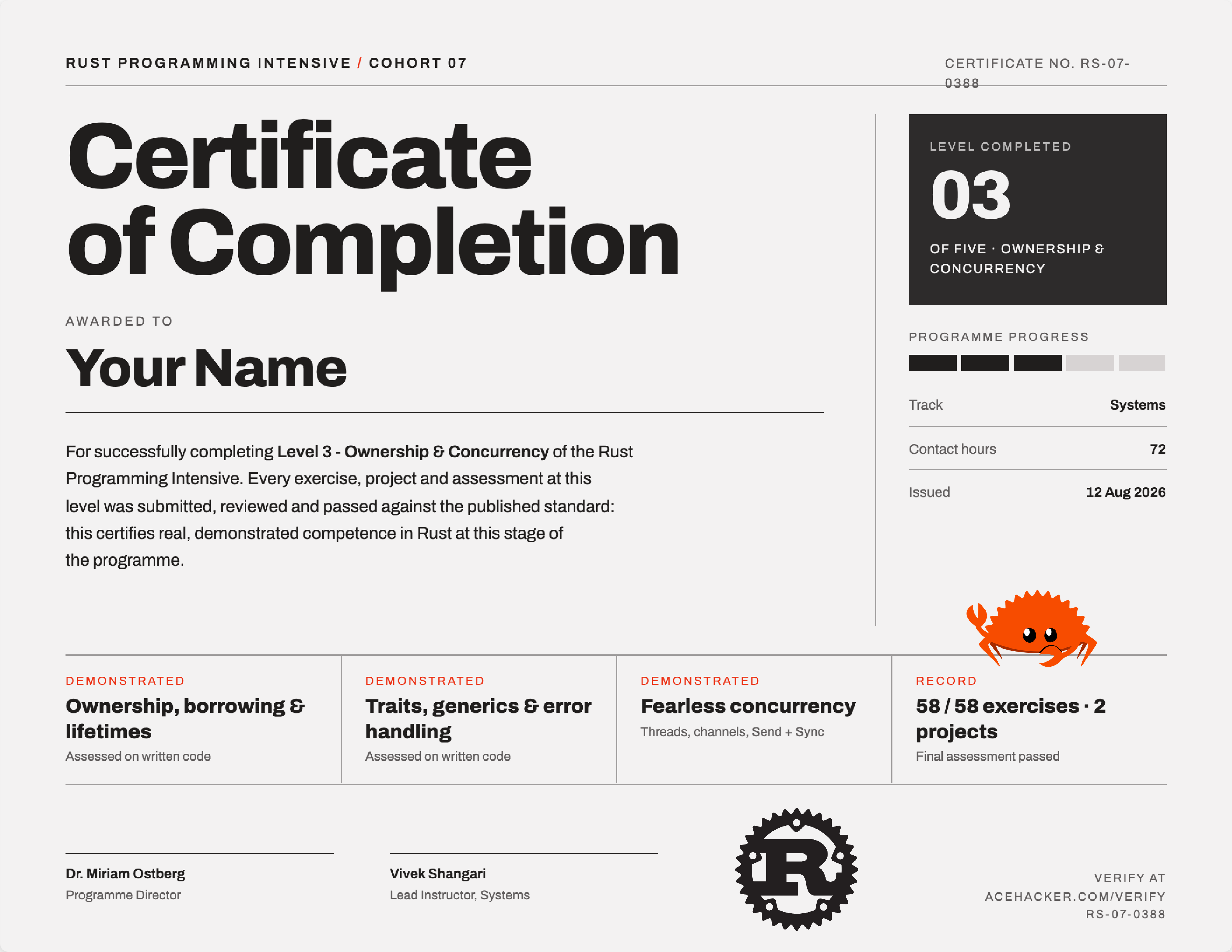
Certificate of Completion

Certificate of Completion in Rust

Awarded on successfully completing a level, marking real, demonstrated competence in Rust.

Sharpen your axe

You learn Rust by writing Rust.

Every week is packed with hands-on work: lab exercises, real projects, and competitions that turn theory into instinct, and fill your portfolio while they are at it.

Four levels of difficulty
Exercises

Four levels of difficulty

Coding challenges and borrow-checker puzzles that push you to think in ownership and lifetimes.

Beginner checks understanding. Intermediate adds depth. Advanced is genuinely hard. Expert is where legends are forged.

Types of Projects
Projects

Cornerstone to Capstone

Hands-on builds, some solo, some as a team.

A Cornerstone CLI in Beginner, a published Keystone crate in Intermediate, and a high-performance Capstone systems tool in Advanced.

Competitions
Competitions

Compete to level up

Sprint coding contests, marathon hackathons, and speed-and-safety challenges, some solo to build independence, some as a team to build collaboration.

The themed hackathon

The Rustacean Rumble

Every cohort ends in a live hackathon. Grab your crew, pick a challenge, and build the fastest, safest tool you can before the clock hits zero. Concurrency encouraged, panics discouraged, and the borrow checker is watching.

Ship a working Rust project, demo it to the room, and the sharpest builds walk away with prizes, glory, and a very smug little crab sticker.

Rust Hackathon
The Ace Hacker classroom

What to expect.

Live, interactive sessions with real teachers, real snacks, and a room, physical or virtual, built for hands-on learning.

BYOD

Bring your own device

Any laptop that can run rustup works, Windows, macOS, or Linux. We will help you install Rust on day one. Code alongside the instructor and take your work home.

Your teacher

Infectious passion

Your teachers' enthusiasm rubs off. Under their guidance you build not only the skill to succeed, but a genuine love for the craft that lasts for years.

Be punctual

The door closes on time

Arrive early for snacks and chai if you are onsite. Class starts sharp on time, and late entry after we begin may not be allowed, so the flow stays unbroken.

Looking for us?

Ace Hacker, Bengaluru

3rd Floor, No. 670, RBI Layout Main Road, J.P. Nagar 7th Phase, Bengaluru 560 078, Karnataka, India.

connect@acehacker.com  •  (+91) 988.011.2117

Vivek Shangari
Who teaches

Taught by people who ship Rust.

Your lead instructor is Vivek Shangari, Chief Geek at Ace Hacker, joined by a small team of engineers and teaching assistants who write Rust in anger, not just in slides.

They have spent years turning nervous beginners into confident builders, and they genuinely enjoy the moment the borrow checker finally clicks for you.

Ready to oxidize?


Write code the compiler is proud of.

Learn Rust from Ace Hacker and build fast, safe, elegant software.

Book your seat → Talk to us first
Questions

Everything else you might ask.


No. You do not need any prior programming experience or academic qualification to learn Rust. Starting from basics, this course provides a strong foundation in programming fundamentals & advanced topics using Rust.


Yes, via EMI on select bank credit cards including SBI, ICICI, Axis, HDFC, Kotak, HSBC, and others. Tenures and interest are set by your bank, and the arrangement is strictly between you and the bank. Choose the EMI option at payment with an eligible card and review the bank's terms.


Yes. On successfully completing the course, you receive a Certificate of Completion, or a Certificate of Excellence for standout performance across exercises, projects, and competitions.


Fully live, with real-time interaction with your instructor and classmates: synchronous learning, immediate doubt clearing, Q&A, and office hours. We strongly discourage missing class, but if something unavoidable comes up we will share a recording so you can catch up.


No. Any reasonably modern laptop running Windows, macOS, or Linux that can install Rust via rustup is fine. Rust compiles happily on modest machines; you do not need anything fancy to learn or build with it.


We have a no-questions-asked policy: after attending at least two classes and before the third, if the course is not the right fit, we refund your paid fees excluding non-refundable charges such as GST. Refunds are processed within 14 working days. To initiate a refund, email connect@acehacker.com from your enrolment email address with your name, Student ID, and course start date.


Yes, under the Ekalavya Scholarship program. Reach out and tell us your story.


Absolutely. For a cohort of 25 or more, email connect@acehacker.com, call (+91) 988.011.2117, or use the contact form. We can tailor pace and projects to your stack.


Vivek Shangari, Chief Geek at Ace Hacker, with a small team of engineers and teaching assistants who write production Rust.

Still deciding?

Ace Hacker Customer Support


Talk to a human.

Questions about levels, timings, or whether Rust is right for you? We are happy to help you figure it out, no pressure.

connect@acehacker.com (+91) 988.011.2117 Fill this form